
You are Witnesses
Ascension Sunday
Scripture: Acts 1:1-11
Watch the sermon on YouTube / View the Bulletin
Does anyone wonder who Theophilus is? The book of Acts opens with the author addressing someone named Theophilus, saying, “In the first book, Theophilus, I wrote about all that Jesus did and taught from the beginning until the day when he was taken up to heaven.” We do know that the first book the author is referring to is the gospel of Luke – and we know that the author of Luke and Acts is one and the same. We don’t know anything really--about Theophilus. The name means literally Lover of God, and so Theophilus might be a person who was interested in becoming a follower of Jesus, or really just a name addressing all who claim to love God. Pretty cool? I thought so.
The author recounts that forty days pass after the resurrection, during which time Jesus continued to appear to disciples, teaching about the kingdom of God, and directing them to stay in Jerusalem until they received God’s promise of the Holy Spirit. On the fortieth day, they’ve gathered together with Jesus, and they ask him: “Is this the time when you will restore the kingdom of Israel?” How very exhausted Jesus must be to have to tell them yet again that that is not what he’s really been about. Jesus moves on quickly, and what he does remind them of is that the power they will be getting is the power of the Holy Spirit. What the disciples will be- are witnesses of Jesus to the ends of the earth. Then, Scripture tells us that he was lifted up into heaven and “a cloud took him out of sight”. Now this is a bit of a strange scripture so if you are new to church today and you’ve never heard this story before—don’t feel bad—it is weird and even those of us who hear it year after year still wonder about it!
In the church we call this the Ascension. Can you imagine what the disciples were thinking that day? My guess is that they were all standing there looking up and saying, “Where did he go?” Or, “did that really just happen?” Or, “what do we do now?” And that’s when they hear this voice. And there are two men dressed all in white, saying “Men of Galilee, why do you stand looking up toward heaven? This Jesus, who has been taken up from you into heaven, will come in the same way as you sow him go into heaven.”
I love these messengers. I need some in my life. I think that sometimes we need people like them who call us to redirect our attention from gazing up at the clouds to the world we live in now. And we need them to remind us that we have a task here as Jesus’s disciples. The Ascension, is almost like Jesus passing the baton to the disciples (and us) as we are left as witnesses to his life and work, and we are called to BE the church. And we won’t get very far in that work if all we do is keep looking up with our heads in the clouds-as tempting as that might be!
Let’s rewind a little because what I find fascinating are the parallels here between this account of the Ascension and Luke’s account of the Resurrection. Remember, on Easter Sunday, we read that the women came to the tomb and found it empty. But as they were wondering over the empty tomb, two men in white appeared, even as the women were gazing at the emptiness, to ask: “Why are you looking for the living among the dead? He is not here; he is risen.”
At Easter, the messengers of God help to direct the attention of the Jesus-followers away from wherever they gotten stuck at, and instead to redirect it to getting moving, getting the message out, getting the news announced - Jesus is on the move, not stuck in a tomb of death! Jesus is on the move, and the women have to get going to help tell the story.
I think the same thing is happening a bit here at the Ascension. The disciples are gazing up at heaven, because the only thing they can focus on is that Jesus is gone-gone. Yes, he’s resurrected. Yes, he’s conquered death. But in that moment, when he’s leaving earth, not going to be with them physically any longer, I can only imagine that they are overwhelmed with anxiety and fear and loneliness. And so they gaze up at the sky, hoping perhaps to catch one last glimpse. The messengers of God appear to pull them back into their present reality. Why are they gazing up at heaven? Jesus’ work on earth - at least in that way - is done. Now the work of the disciples is about to begin, and it’s time for them to get moving!! So, what’s next?
The whole Book of Acts is about what happens next. Today’s reading is the very start of that book. And it’s what happens when the disciples become the first church. It’s about how they go from this small group of people who followed Jesus to a community that grows and spreads and endures to this day. Yet, it starts with this: the disciples looking up in the clouds and getting their attention called back to the world they have been asked to serve.
The disciples’ worlds had been completely changed by a man who preached a different truth and proclaimed a new way of living into God’s word. In three short years, Jesus’ ministry had changed so many lives and then he was crucified, but then the tomb was empty and resurrection had prevailed and now he has ascended and what happens next?
Well, they/we keep on keeping on! We are witnesses! Jesus said, “You are witnesses of these things” and I believe, with all my heart, that those words were as much meant for us as they were for the disciples he was speaking to that day. Because we are! We are witness of the works Jesus did in his life. We are witnesses of his miracles, of his teachings and of his love. We are witnesses of the ways our own church is making an impact, not only in our community, but throughout the world, as well.
We are the ones who are left to carry out the work of Jesus. He’s made us his body, his hands, feet and voice in the world. To us, to you, to me, Jesus has entrusted the carrying out of all of his hopes for the world. Rev. David Lose writes, “Jesus leaves, but we stay. As it turns out, this is the ultimate "left behind" story, but according to Jesus, being left behind is neither a sign of imperfect [our] faith nor a chance to prove [ourselves] worthy. Rather, being left behind is an honor, an invitation to participate in the glory of [God], a commissioning, in fact, into the work of [God.]” (Working Preacher)
People of Fairport UMC, if our heads are in the clouds…it’s time to redirect our gaze. We, the body of Christ, is right here, in this very room --ready to love and serve and be God’s witnesses, even to the ends of the earth.
Holy Spirit Fruit (Open to the Holy Spirit)
Following the Historic General Conference
Scripture: John 15:8-17 & Acts 10:44-48
Watch the sermon on YouTube / View the Bulletin
The lectionary readings this morning—are incredible when we think about the important 2 weeks we just had for our denomination!
We could have just focused on our gospel reading today and that would have been great on its own but when we look at both Jesus’ teachings on loving our neighbor—and Peter in Acts (back to Peter!) needing a lesson on who our neighbor is—and that loving our neighbor has no boundary it is even better!
Let’s start with our Gospel reading this morning. We have more vines—and abiding just as we did last week. Last Sunday we read about how Jesus was preparing the disciples for a time when he would no longer be with them and instruct them in a very pastoral and compassionate way (using a vine metaphor) that he is the vine and they are the branches and that they must stay close to the vine. They are to abide in him—as he abides in them. And in our reading today Jesus continues encouraging the disciples saying that just as the branch cannot bear fruit by itself, they can neither love one another nor bring other to faith apart from “abiding in the love of Christ.” The vine is the source of life and everything that flows from it!
Love one another as I have loved you. These are some of Jesus’ last words and teachings before he dies. Again, preparing them for a time when he would no longer be with them. Love one another as I have loved you. Love, Love, Love. Sounds simple enough. But oh how we have gotten is so wrong so many times. As individuals and a church. Right?
All that has happened in the last two weeks (General Conference) leaves many people—me included—with many complicated feelings. Maybe you too?
I am utterly thrilled, of course. We have so much to be thankful for this week after an historic General Conference!
The Ban Gay Clergy and Gay marriage—lifted.
Harmful language removed from the discipline.
I also find that I am still furious at the harm we have caused to so many. As a straight, white, female, I have not been targeted the way the LGBTQIA+ members of our UM family have been. Of course. But the scars and hurt of our exclusiveness—discrimination—are still there and it will take time to heal.
I read this statement on FB this week from Dorothee Benz entitled: Bring on the Services of Repentance
Yesterday, after a half century of spiritual violence, systemic discrimination, and institutional gaslighting, the United Methodist Church finally voted to lift the anti-queer language in its Book of Discipline. It’s a day I despaired of ever seeing. I was driving home when the news hit me and I started to cry uncontrollably. My tears confused me. Wasn’t I happy? Wasn’t this the thing I sacrificed so many years of my life to bring about? Yes, it was. But it turns out it’s not that simple. I don’t know why this had never occurred to me before, in the many years that I dreamed this day would come – the end of this particular era of codified discrimination does not undo the immense harm the church has done to countless thousands of people. My tears were tears of joy, sort of, but mainly tears of grief and anger at the pointless brutalization of *generations* of young Methodists who tortured themselves because they were taught by their church their God-given nature was sinful; clergy who sacrificed wholeness to follow their call or risked their careers or were drummed out of the church; untold thousands of queer people that fled the church. And those who did not live to see this day.
Look around you. Who is not there? For many of us, it is too late...
And then she urged us to continue the work. For it’s one thing for our denomination to have changed its stance but there will still be many local congregations that will not embrace this change. This church was and will continue to be an important part of the fight as we move forward—to bring about healing and love to our world. There is still more work to be done…more living and loving. And we do this with the Holy Spirit guiding us—leading us forward each day. And our Acts text this morning has a thing or two to say about the Holy Spirit!
When we drop in on the story this morning—it is clear that obviously something has happened before started—and it is like we’re just walking in on the end of the movie and only those who have seen it before will know what is going on. So, I’ll get you up to speed:
First Peter meets Cornelius (a Gentile) in Caesarea by the Sea, then moving on to Joppa, Peter goes up on the roof to pray— Peter is famished and God gives him a vision of animals of every kind—unclean animals. And then he hears … “Get up Peter, kill and eat” Peter answers God, “Never!” This happens 3 times. Then in a puzzled state he goes to the door where there were three men—sent by Cornelius to fetch him. Peter goes with them still trying to figure out all of this. When they reach Cornelius’s house, Peter is trying to understand what God is up to—the unclean animals in the vision—a gentile house hold. On one hand Peter thinks that he should not be associating or visiting a Gentile…but as he’s putting the pieces together—he realized that God is trying to tell him something. God has shown him that he should not call anyone profane or unclean….
Peter then preaches a short sermon about Jesus. That’s when our text began today. While Peter is still speaking—before any baptism, confession of faith, new member class—the Holy Spirit fell upon all who heard the word. Peter says “Can anyone withhold the water for baptizing these people who have received the Holy Spirit just as we have?”
Peter echoes the question of the Ethiopian Eunuch that we heard about last week when he asks Philip: “What is to prevent me from being baptized?”
The Holy Spirit surprised Philip on a desert road (last week) and they Holy Spirit surprised Peter in Cornelius’s house in our reading today. The Holy Spirit can be unpredictable and disruptive.
Church Historian-Rosemary Radford Ruether says that the church must be organized to do 2 things:
TO pass on the tradition from one generation to another
TO be open to the winds of the Holy Spirit by which the tradition comes alive in each generation.
Jesus modeled this in his ministry—over and over again.
He opened their minds to scripture and told them the Holy Spirit would come.
I truly believe that what we saw happen at General Conference this past week was the work of the Holy Spirit.
Sometimes tradition becomes so rigid that the Holy Spirit can hardly find a crack to bring any new word. Sometimes the Holy Spirit has a hard time getting through our stubborn desire to stay the way we are. Sometimes the Holy Spirit gets in and can change a church—a denomination—and shows us that once again, LOVE WINS. Every single time.
Dear ones, may be continue to be open to the winds of the Holy Spirit- Lets be like Phillip—Peter—Like…well, Jesus. And love one another as Jesus loves us. Amen.
Branching Out
Fifth Sunday of Easter
Scripture: Acts 8:26-40 & John 15: 1-8
Watch the sermon on YouTube / View the Bulletin
Vines, Vines, Vines! Are you ready to learn more about vines than you ever thought you wanted? Just kidding. We have an image that Jesus uses with his disciples that requires a little information that maybe the regular non-gardener might need to know. And important to note: this week’s image of “the vine” would have been familiar to many early followers of Jesus: Isaiah, Ezekiel, and the Psalms each make use of it. We shouldn’t forget that Jesus’ teachings are grounded in the Jewish scriptures.
In a vineyard, the best grapes are produces closest to the central vine. And that really does make sense as the nutrients are closest to the vine! Left alone, vines will grow uncontrollably and result in one big tangles mess! A vine grower or a vinedresser is needed to keep the vines in orders. The lateral branches need to be pruned and kept short.
Jesus uses this image/example as a description of the life of discipleship. Jesus is the true vine, God is the grower and we are the branches.
It’s a hard one to hear in some ways, isn’t it? It starts off like a word of judgement as we hear about branches being cut off—and some pretty hard pruning. And there could be a pretty harsh sermon on this but I think you know me better to know that is not my way. When I look at this text—I think it’s important to think of the big picture here and try to understand why Jesus was sharing this with his disciples in the first place. Let’s leave the cutting of branches and pruning—to God—trusting that God knows what will help us to bear fruit!
So what does this have to do with our faith life?
In the gospel of John –where we find ourselves this morning- Jesus is in the midst of what’s sometimes called his “farewell discourse” to the disciples, who are understandably distraught. Here was the Messiah, and now he's leaving? Now he's going to suffer, to be humiliated, and die? The disciples are a mess. Jesus is preparing them and offering excellent pastoral care, assuring his friends that his leaving them is not abandonment, but rather will make way for an even deeper relationship with him. It’s as if he is saying: Yes, I’m about to leave; but on a deeper level, I’ll still be with you, even closer than before. Don’t worry — trust me! And abide in me.
The Message by Eugene Peterson puts it this way: “Live in me. Make our home in me just as I do in you.”
The vine metaphor can sometimes be used like this: “If you want to live, you’d better stay connected to me, or else”. That’s not where I go. It’s, “Don't worry, we'll be together; your life itself and all its fruit will testify to our ongoing intimacy. Take heart: I will be with you, and our companionship will be even closer than it is now. Today we walk side by side — but in the days to come I will live in you, and you in me. Today, you walk in my footsteps — but in the days to come you will walk, so to speak, ‘in my feet,’ and I will walk in yours. Indeed, you will be my hands and feet for a world that needs healing and good news. Friends, I’m not abandoning you! On the contrary, I will abide in you, and you will abide in me. I will not leave you alone...” (SALT Project)
Now, let’s fast forward to Acts---and the disciple Philip. What is interesting with Philip is that this is the disciple we learned more about this past week in The Chosen Bible Study! And one observation from someone in class was that Philip seemed to have such an easy going attitude---as he met people where they were. At least that is what was depicted in the movie---and actually what we see in scripture this morning here in the book of Acts. We see yet another disciple living out the teachings of Jesus.
So, what’s going on in Acts? This week’s passage shows us the Jesus movement opening up also to include Gentiles (that is, non-Jews as well as Jews). The Ethiopian eunuch, is an outsider. For Luke, an “Ethiopian” meant anyone from territories south of Egypt, a region some ancient writers depicted as the outer edge of the known world. As a Gentile whose status as a eunuch meant he traditionally could not become a Jew (a eunuch was a castrated male), his conversion foreshadows Cornelius’ conversion (Acts 10-11), which in turn inaugurates the official Christian mission to the Gentiles. Thus this text is setting up and expanding circle of inclusion within God’s good news of salvation. All such good news! (SALT Project)
Philip—as one who is clearly abiding in Jesus—is able to branch out and expand the circle of inclusion. And he does it in a beautiful, non-threatening/non-scary way. He meets the Ethiopian eunuch exactly where he is. He comes alongside him and shares the good news of Jesus. He takes this moment empowered by the Holy Spirit as the ultimate “teachable moment”.
The question for us today is what does it look like to abide in Jesus?
Perhaps it looks like Philip---abiding in Jesus---listening to the Holy Spirit.
Perhaps it looks like us being the people God made us to be.
Perhaps it would look like love: incarnate, tangible, down-to-earth, growing, fruitful, love.
“When the Ethiopian eunuch appears in the story, he already has a copy of Scripture. What he is missing is someone who will guide him in his reading of it, joining him where he is, to answer his questions with inspired conviction.” (Barbara Brown Taylor-Feasting on the Word).
And then he was baptized. What is preventing me from being baptized? Nothing. Absolutely nothing. So Philip baptized him right then and there.
“Walls of prejudice that had stood for generation came tumbling, blown down by the breath of God’s Holy Spirit, and another man who felt lost and humiliated was found and restored in the wideness of God’s grace in Jesus Christ.” (Thomas Long, Feasting on the Word).
We have incredible stories today of the early church. May they inspire us and call us to abide in Christ-- to take our faith on the road, with the Holy Spirit guiding—and meet people where they and love them.
May it be so. Amen.
Practicing what HE preached!
Third Sunday of Easter
Scripture: Acts 3:12-20 & Luke 24:36b-48
Christ is Risen! Christ is Risen indeed!
I thought we’d practice it again this morning as we are still in the season of Easter! Perhaps the first disciples also need to practice it because, according to our reading this morning, they still are having a really hard time wrapping their heads and hearts around Jesus’ resurrection and all that has happened since his death! And we can’t blame them, can we?
Luke shares a great post resurrection story of Jesus and the disciples this Sunday. The disciples are still unsure of the state of ---everything! What we do know is that they are huddled together behind locked doors—afraid. The world has been turned upside down and it nothing seems to make any sense. What happened? Who can be believed? What testimony is credible? What is next?
A little context for our reading today from the Gospel of Luke-- Two disciples had just returned from an encounter with the Risen Christ on the Road to Emmaus—where Jesus was revealed to them as they broke bread together…and this comes after the women told the disciples about the empty tomb. And now, here they are locked in a room sharing these stores---and Jesus shows up and they still don’t recognize him---they think they are seeing a ghost! Which, by the way, is not the first time they thought Jesus was a ghost---remember back (early in Lent) when Peter walked on water?
Such a range of emotions they all must be experiencing! They are really struggling to take in all these reports and they are definitely not quite ready when Jesus shows up in mid-conversation. And yet…he meets them exactly where they are, in the midst of their doubt, guilt, frustration, being frightened, grief, overwhelmed, and confusion. What do you think you might be feeling if you were one of the disciples?
Jesus appears those providing words of comfort, assurance and encouragement. He offers them peace, asks them why they are freaking out and then invites them to touch and see. Finally he encourages them to move beyond where they are. To move beyond the fear, doubt, guilt (etc.)
Jesus opens their minds to being to see that death is not the final word. He helps them to see that they are set free and commissioned to become witnesses. He could have launched into explanation about the how to-s of resurrection---or he could have given them an itinerary of his whereabouts since Friday but he didn’t. (Although, I admit, that would have been pretty cool.) Instead, Jesus taught: That his whole life death and rising were about what God was doing in the world—reconciling the world to God. From the law of Moses to the prophets to the Psalms---it has always been about God and God’s purposes for all of creation to be reconciled and made whole. The risen Christ appeared to groups and couples to give them assurance that HE LIVES and teaches them to put their fears and doubts aside as they contemplate the bigger picture! Scripture has been fulfilled. Jesus is saying to them, that they have seen in him the fulfillment of God’s plan for the world’s salvation and they are called to share that witness.
Fast forward just a little. And we now find ourselves in the book of Acts and we are back with Peter! Again! Our old friend! Peter who denied Jesus 3 times at the crucifixion and then proclaimed to love Jesus 3 times—as if that was Jesus’ way of redeeming Peter and forgiving him without so many words.
Between the encounters with the Risen Christ and with the gift of the Holy Spirit that has been poured out by the time we get to this part in Acts—the disciples (and Peter) were now ready to be witness in Jerusalem and to all nations!
Perhaps they just needed a little more Jesus-a little more patience-a little more teaching-a little more time- to wrap their heads and hearts around what God was doing! And what we finally see in when we get to Acts is all of this coming to fruition! Of course they have the power of the Holy Spirit which is no small thing! It is everything.
See, Pentecost (the outpouring of the Holy Spirit) had already come by the time we get to Act 3 and what has just happened and what Peter is talking about is that a lame beggar in Jerusalem has healed outside the temple. And people misunderstood the source of the healing---that it was by Peter and John when, in fact, it was God doing the healing—through Peter and John. Peter needed to set them right. Bold Peter—getting things right! Note: we must remember, Peter, is speaking to fellow Jews about Jesus, who was also a Jew. Peter is not a Christian missionary, telling Jews things that they do not already know. He is one of them arguing with them from their own Scripture and tradition about one of their own, whom he accuses them of abandoning to the Romans. His sermon is an insider’s sermon. And we need to remember not to let this text turn in anything anti-Jewish. That is not the point. The point is the resistance.
He was finally practicing what HE (Jesus) preached and taught so many times! Peter is pointing out to the community all the ways they rejected and resisted Jesus-the Messiah.
Friends, what are the ways in which we resist? What are the ways that we resist resurrection? What are the things we hang onto—guilt, unrealistic expectations, and the familiar? What do we need to let go or surrender to in order to embrace the hope of new life—new beginnings—of God doing a new thing in our midst?
Peter’s sermon here was calling his community-challenging them with exactly what Jesus taught and preached-pre and post resurrection—to turn around and to repent—to change their minds. How do we as a church and as individuals need to repent? How do our minds need to be changed?
Two thousand years ago Peter—practicing what Jesus preached—in his own preaching changed the world. His preaching was legendary. As Barbara Brown Taylor states: “Christ’s church may have born in a graveyard, that that baby grew quickly, beyond anyone’s imagination.”(Feasting on the Word, Year B, Vol. 2)
Here again, Jesus’ words: “This it is written, that the Messiah is to suffer and to rise form the dead on the third day, and that repentance and forgiveness of sins is to be proclaimed in his name to all nations, beginning from Jerusalem. You are witnesses of these things.”
Peter took Jesus’ words and ran. Practiced what He (Jesus) preached. May we be bold to do the same. Amen
Wandering Heart: Here’s My Heart
Second Sunday of Easter
Watch the Sermon on YouTube / View the Bulletin
I must say that the piece of the Gospel Lesson that stands out for me is this verse:
“Very truly, I tell you, when you were younger, you used to fasten your own belt and to go wherever you wished. But when you grow old, you will stretch out your hands, and someone else will fasten a belt around you and take you where you do not wish to go.”
The last time I preached here was in February 2022. I was in the midst of an involved diagnostic process. I’d woken up on New Year’s Day of 2022 with a lump on the side of my face. One thing led to another and a few weeks later I was scheduled for a surgical biopsy at Rochester General.
A few days before the surgery, I was summoned to the hospital – I felt like out of the blue – for a regimen of pre-surgical tests. No one had told me ahead of time that was a part of the deal. So I found myself feeling a bit resentful and put upon that I needed to drive up there early on a Monday morning. I felt like my life was no longer my own.
when you were younger, you used to fasten your own belt and to go wherever you wished. But when you grow old, someone else will take you where you do not wish to go.
But an interesting thing happened as I drove up there that morning. It dawned on me that maybe this was all part of a larger process that really wasn’t in my control, and I just needed to hand myself over to it. Where I wished to go really didn’t matter. This was out of my hands. My wandering heart needed to answer a call to a larger and more pressing story. I needed to trust others to be in charge. My life wasn’t my own. I had entered a different world I didn’t really understand.
At the first Easter Peter and the other disciples had entered a different world they didn’t really understand.
It’s worth noting that the tone of the days following the first Easter is not joy. There were a whole range of emotional and attitudinal responses. There was bewilderment. There was wonder. There was curiosity. There was fear. And then there was some guilt and shame as well.
As Peter tries to come to terms with that first Easter, he’s coming off some hard days.
Let’s remember, of course, that Peter had sworn up and down when he talked to Jesus before the crucifixion that he would never turn away from him. He would never abandon his teacher.
Jesus, of course, knew better and told Peter that, in fact, before the morning would arrive, Peter would deny Jesus three times. And that’s what happened. Peter denied three times to folks around him that he even knew who Jesus was.
As this series on Peter’s wandering heart has highlighted, Peter comes across in the Bible as a person who wants to do the right thing. He is typically motivated to step forward and take charge. He is portrayed as decisive, if not impulsive. So, his grandiose self-confidence in the face of Jesus’ warning is not a surprise. Nor is his failure to live up to his own ambition.
And then Jesus was executed. Peter felt like he let Jesus down at the end. His last opportunity to be faithful and he blew it. After making a big deal that he would be loyal, he caves.
And this situation is, of course, complicated by the problem of what to do after the crucifixion. Peter and the other disciples have to figure out: What’s next for us?
They had left their prior lives behind to follow Jesus, and there is no obvious way forward. To them the Jesus story is over. Dead and gone. So, in our reading this morning, we find them back fishing – the old agenda. The Jesus business is done.
But Jesus appears, and just as he did at an earlier fishing episode, directs Peter to a huge catch of fish after a night of fruitless effort.
Jesus’ appearance is mysterious, intimidating, and dramatically unsettling. This is a decidedly “rock my world” situation. But Jesus has prepared breakfast and offers them to join him in the meal.
As I read the passage, it feels to me like that meal begins to bring Peter and the disciples into this new world Jesus has opened up. Breakfast really can be the most important meal of the day.
But the invitation back into Jesus’ story puts Peter at a crossroads: Jesus asks him three times whether he loves his old fishing agenda more than the agenda of shepherding the flock Jesus has gathered. Are you willing to trust yourself into my agenda, my way, my love, my life?
Easter puts Peter at a crossroads, and we may find ourselves at the same crossroads:
Will we follow our wandering heart? OR
Will we follow Christ’s heart with a courageous and confident wonder?
Before this Peter had thought that his bluster and grandiosity was his strength. He had relied on his impulsiveness to dominate his situation and those around him. But in this Easter transformation, Peter has to wonder again whether he had it right.
Peter and Jesus had had some arguments about what it might mean to be strong. Jesus had said time after time, in a variety of ways, that to be strong is not to be in a position to dominate others, but to find ways to love others.
The strong person is not the one who succeeds in a rivalry with others. The strong person is the one who has the capacity to engage rivals into reconciliation. The strong person is the one with the patience and the presence to love the world into peace.
Strength is the ability to hold onto the truth, even when that truth is uncomfortable to bear and even when that truth is about our own limitations.
Strength is not about building up strong defenses, but rather about being open, vulnerable to the good, the beautiful, and the just.
Not high walls, but wide bridges.
And the question naturally emerges – but is that safe? Will we be secure?
Good Friday reminded us that even Jesus was not safe in this world.
And, in its turn, Easter reminds us that not even the worst is the end. It is the prelude for God’s response. The setting for God’s wondrous action.
The crucifixion of Jesus, his descent to the dead, and his resurrection drive home to us that God does not abandon us in the midst of trouble, pain, sin, or death, but instead continues to embrace us into the future with love.
The Easter Story is the sign that new life can be on the other side of evil, suffering, and death. Ultimately our stories become part of God’s story; all our stories are being gathered up into love.
That was my experience as I was led where I did not wish to go. I was gathered up into love. Part of that was the love of this congregation in notes, cards, calls, and prayers. Another part were the compassionate health-care workers of all kinds who took care of me.
So, can we hear that? Can we live that?
All our stories are being gathered up into love.
All our stories are being gathered up into love.
Of course, some will be drawn in kicking and screaming. Some will feel it is a plot against them. Some will be drawn in only in fear. Some will be bewildered the whole way.
But some of us – especially those of us who take the Easter message to heart – will go with the assurance that, yes, it’s out of our hands. When we were young we went where we wanted, but now we are being invited to trust ourselves into love.
To give up following our wandering hearts and follow Christ’s heart in wonder, open to whatever comes next.
We are invited to say: Here’s my heart!
Thanks be to God!
Wandering Heart: And I Hope
Easter Sunday
Watch the Sermon on YouTube / View the Bulletin
Happy Easter! It is a blessing to worship with all of you this joyous Easter morning. It has also been a blessing to journey with many of you through the last 47 days of Lent. Our wandering hearts have been making their way toward God, learning about ourselves and discovering more about our faith together. And it has been a blessing. Today we continue to do more of the same! The Easter story is full of mystery, grace and wonder. A Pastor was doing a children's sermon when a young boy, four or five, raised his hand to ask a question. "Pastor," he asked, "if they dusted the stone that was rolled away from Jesus' tomb, would they find God's fingerprints?" And the Easter story has God’s fingerprints all over it!
First, let’s start with the women because that’s where the gospel starts today. I think it’s a pretty good place to start too. In the Gospel of Luke, the women come to the tomb where Jesus’ body had been laid just a few days before, and to their surprise, instead of finding Jesus, they find angels. The angels tell the women, “Jesus is not here,” and when that answer is met with confusion, the angels say, “Remember what he told you.”
Remember. It’s one of the words Jesus used at his last supper, and it’s one of the first words we hear at the empty tomb. Remember. I can’t help but wonder, there in that garden as the sun rose over the trees, if they remembered it all.
I wonder if they remembered Jesus telling 5,000 people to sit together in the grass, passing out baskets of fish and bread.
I wonder if they remembered how he stopped in the middle of the crowd to ask, “Who touched my robe?”
I wonder if they remembered how he ate with Zacchaeus or scooped up the children onto his knee.
I wonder if they remembered him teaching in the temple, telling people, “Love your neighbor as yourself.”
I wonder if they remembered how the wind stopped with the sound of his voice.
I wonder if they remembered how he washed their feet and said, “This is my body, broken for you.”
I wonder if they remembered it all. . .
The women returned to where the rest of the disciples were and told them everything---Jesus was not there. He had been raised from the dead (just like he told them). This might come as a surprise but the men didn’t believe them. It seemed like an idle tale---and that saying it nice. The actually word in Greek is rubbish—garbage. It seemed like garbage. But Peter knew better. Perhaps Peter, remembered all that Jesus had said and despite all odds.
“Could it really be true?” is the question I think Peter asked himself, and with hope on his heels, he ran to the tomb to see for himself. (Dr. Karoline Lewis, A Sanctified Art Commentary)
And that is resurrection hope. The hope of an empty tomb even when one hasn’t encountered the risen Christ yet. (That story is for next week!)
The last 6 weeks we have been following Peter-one of Jesus’ disciples. We have been figuring out faith with Peter. Peter has shown us that a life of faith isn’t perfect-it’s a journey with twists and turns. It is a journey that will have some highs and lows. It is a journey where we are constantly learning and growing. During Holy week we journeyed with Peter and his guilt (denying Jesus-abandoning Jesus) and his immense grief. That is where we left Peter just 2 days aga on Good Friday. I have to say, I heard the Good Friday readings in a different light this year. Maybe you did too. I feel like I know Peter a little more than I did before Lent began. All this time trying to understand him and his faith, really made me hear his story in a new and powerful way on Friday. And as I heard the gospel read and I heard the way he denied knowing Jesus and being one of his disciples---my heart broke. Did yours?
Peter—the Rock on which Jesus would build the church.
Peter—the one with enough courage to walk on water---and to ask Jesus for rescue.
Peter—the one boldly proclaiming Jesus as the Messiah—Son of the Living God.
Peter—who has been following Jesus for 3 years witnessing miracle after miracle—healing after healing—including his mother-in-law---watching Jesus retore life where there was despair, isolation and death.
Peter—who saw Jesus transfigured.
Peter—who watched Jesus set his face toward Jerusalem—and not turn back.
Peter—who had his feet loving washed by Jesus.
Peter—who drew his sword, denied Christ three times, who was not there when Jesus died.
Maybe the reason my heart broke because I can see a lot of myself, my faith, my journey in Peter’s story. Maybe you too?
We might expect that, after denying Christ, Peter would cower in shame—or perhaps even run away in an attempt to leave his past behind him. Instead, when he hears the news from the women, he doesn’t dismiss them like the other disciples. He gets up and runs to the tomb. I wonder, really, if Peter runs to the tomb because he believes the women or because he doubts the women’s story? And then maybe it doesn’t matter why he goes—for the tenacity of hope drives him there.
Even after the biggest failures, even after the worst-case scenario has happened, can we run toward hope? Like Peter, will we keep going? Will we keep looking for God in our midst?
Just when we think that Peter’s story might be a tragic one—one that maybe he won’t bounce back from—we hear that Peter ran to the tomb.
Our theme song/hymn this Lent has been: Come Thou Fount of Every Blessing. We’ve used phrases from there to parallel Peter’s story---and our story. There’s a line in the 2nd verse---- “Here I raise mine Ebenezer; hither by thy help I’m come; and I hope, by thy good pleasure, safely to arrive at home.”
And I hope. And I hope.
Peter shows us that we can always begin again. We can add an “and” when we think our stories have come to an end. Friends, the end is never the end. Not the way we think. The story didn't end for Peter at the courtyard, nor for Jesus at the cross. Not for us. We can always begin again.
Peter was in awe at what he saw. What he experienced. Peter goes home wondering and it’s in that wondering that the meaning of the resurrection lies.
The resurrection only makes sense when we remain amazed, marveling and wondering at the love of God that reversed death itself. We are not asked to explain the resurrection, offer proof for the resurrection, or make a case for the resurrection. Instead, like Peter, we live in wonder—for how belief in the God of resurrection truly can change the world. (Dr. Karoline Lewis, A Sanctified Art commentary)
Can truly change us. Perhaps that is what resurrection is all about. The holy “and”. A new beginning? A new life? New beginnings. Transformation. The end is not the end. The resurrection shows us that is true –for Jesus, for Peter and us.
May the words/song on our hearts and our lips this Easter be…And I hope. “And I hope, by thy good pleasure, safely to arrive at home.”
Thanks be to God. Amen.
Wandering Heart: Songs of Loudest Praise
Palm Sunday
Gospel Reading: Matthew 18:15-35
Livestream unavailable / View the Bulletin
Today marks the beginning of Holy Week. The final week of Jesus’ life. It begins here, on what we call Palm Sunday—the Sunday we hear about Jesus entering Jerusalem on a donkey and crowds shouting their hosannas. Some of you may celebrate Palm Sunday every year so this story is familiar but for some of you, you are hearing this story for the first time. So, maybe some context will be helpful.
The big event on the Jewish calendar was the celebration of the Passover. So, many Jewish people were making the pilgrimage to Jerusalem. Jesus and his disciples---and a growing crowd that was following him were on their way too.
There is a crowd walking with Jesus down the Mount of Olives, and up into the city gates. He’s been gaining followers. Then there are people already in Jerusalem who wanted to see Jesus—they may have heard about Jesus or saw Jesus perform miracles in Galilee—and we read that they all spread their cloaks before him and shout “Blessed is the king who comes in the name of the Lord!” But it is also important for us to understand that they aren’t the only people in town. And this crowd coming with Jesus isn’t the only crowd in town.
In the book, The Last Week, by John Dominic Crossan and Marcus Borg they start with this powerful image that I’d like us to think about this morning:
“Two processions entered Jerusalem on a spring day in the year 30. . . One was a peasant procession, the other an imperial procession. From the east, Jesus rode a donkey down the Mouth of Olives, cheered by his followers. . . On the opposite side of the city, from the west, Pontius Pilate, the Roman governor of Idumea, Judea, and Samaria, entered Jerusalem at the head of a column of imperial calvary and soldiers. Jesus’s procession proclaimed the kingdom of God; Pilate’s proclaimed the power of empire.”
Two very different groups of people.
Jesus’ procession carries no weapons. They wave branches in the air, signs of peace, and yet they appear to proclaim a revolution. “Blessed is the king! Hosanna!” Those words sound nice to our ears. They certainly don’t sound very revolutionary. But the really were. They really are. They are calling Jesus, King! There was already a King. And that King-King Herod. And Jesus was associated with John the Baptist, whom Herod had imprisoned and eventually executed because of John's criticisms of his illegal marriage to Herodias. Tensions are high. Can you start to understand the complexity of the political climate?
I wanted to start our scripture passage this morning with a scene right before the traditional Palm Sunday reading because I think it is important to hear about Lazarus and Mary.
Jesus has raised Lazarus from the dead, which intensifies the plots to arrest and kill him—to the point that he retreats into the wilderness with his disciples (John 11:54). The crowds begin to question if Jesus will attend the Passover festival and then, as it draws near, Jesus comes out of the wilderness and travels to Bethany. He stays in the home of Lazarus where he is lavishly anointed and cared for by Mary, an act that Judas questions. Plots to kill Lazarus as well begin to stir. (Karoline Lewis, Commentary for Palm Sunday, A Sanctified Art)
And as the week unfolds Jesus isn’t making any friends. We will hear about Jesus driving out the merchants who were selling and buying in the temple, overturning the money changers' tables, and said, "It is written, 'My house will be called a house of prayer,' but you are making it 'a den of robbers'". He isn’t arrested because the authorities fear the normal Passover crowd. The authorities feared Jesus’ crowd. The crowd calling Jesus, King. Those who were shouting “Hosanna” knew they were making a risky scene. See, Hosanna is often thought of as a declaration of praise, similar to hallelujah, but it is actually a plea for salvation. The Hebrew root words are found in Psalm 118:25, which says, “Please, Lord, please save us!” The Hebrew words yasha (“deliver, save”) and anna (“beg, beseech”) combine to form the word that, in English, is “hosanna.” Literally, hosanna means “I beg you to save!” or “please deliver us!” (https://www.bethlehemhampden.org/blog/hosanna)
Between calling Jesus, King—and then asking him to save them was brave and courageous.
And WHERE IS PETER!!??
Given the swelling emotional intensity of these events, how do you imagine Peter feels as he stands among the crowds? Does he feel exuberant to witness their praise? Does he feel skeptical and scared of anyone who might be trying to arrest Jesus? Is he thinking about when Jesus rebuked him (Matthew 16:13-20), still wishing that Jesus’ words will not come true? (Karoline Lewis)
Throughout the last 5 weeks we have been figuring out faith with Peter—one of Jesus’ disciples. I don’t know about you but this Palm Sunday story leaves me imagining where Peter might be and how he is participating as part of the crowd.
I think it is important for us to remember all the events that have led up to this point. Let us take a moment to look back on Peter’s journey before we move forward into the next few days when his faith will be tested and stretched—and then restored. Let us remember how this all began: with an abundant catch, and a calling to drop everything and follow. Peter has walked on water and clung to Jesus for rescue. He has pronounced his faith confidently and been told to get out of Jesus’ way. He has asked questions and learned about the expansiveness of grace. And now, the end is near. He stands among the crowds as they sing songs of loudest praise.
I imagine him to be caught up in the midst of the celebration. Singing praises with everyone else. Did he…did they…fully understand all that was happening at the moment? Probably not. We barely do and we know the whole story. They were in the thick of it. At the end of the scripture reading today we hear: "His disciples did not understand these things at first, but when Jesus was glorified, then they remembered that these things had been written of him and had been done to him."
“Then they remembered.” When they look back on this experience, perhaps they will remember the songs. Their singing is courageous.
For many years, I’ve preached this passage as a tragic story: look at all those people who misunderstand… they just don’t get it: their hosanna is fickle, and soon will turn into crucify him. They eventually remembered (and understood) what they had gotten all wrong here.
But what if we read this “remembering”, as a positive: they remembered this moment in time when they got it really, really right! They remembered how good it felt to join the cry for liberation. Their soul was able to breathe, and they were not afraid.
I think it’s so tempting, to disregard or even ridicule our failed beginnings, or our own well-meaning attempts in this liberating work. This was the beginning of a week of many wrongs---specifically by Peter. And even if he didn’t understand fully everything that was going on—in the singing, in the praising, at least in that moment he got it right, he is brave, he is courageous. What about us?
Two processions entered Jerusalem on that day.
The same question, the same alternative, faces those who would be faithful to Jesus today.
Which procession are we in? Which procession do we want to be in?
This is the question of Palm Sunday and of the week that is about to unfold.
— John Dominic Crossan and Marcus Borg, The Last Week
Courage
We summon every ounce of courage.
We give ourselves pep talks
and we call our friends.
We dig deep within.
We practice the words out loud,
rolling them around in our mouths,
imagining the response.
We deal out every “what if” card our brain holds on to
and spend absurd amounts of time
imagining all the ways it could go wrong.
And then finally, blessedly, we say it:
I love you.
To speak the truth of your heart takes courage.
It always has.
But please,
summon your courage,
join the parade,
and speak with conviction.
For God has been saying to the world since day one:
I love you.
What is your response?
Overall Series and Poem from : A Sanctified Art
Wandering Heart: Teach Me
Gospel Reading: Matthew 18:15-35
Watch the sermon on YouTube / View the Bulletin
For those of you who are just joining us this week—we are spending this season of Lent with Peter—one of Jesus’ disciples. We are looking at his faith journey---one that was filled with lots of up and downs since Jesus first called Simon Peter from his fishing boat (week 1). Since then, we’ve seen Peter show great courage at times and also falter with lack of trust. We’ve seen him answer some questions right and we’ve seen him completely miss the mark (even if his heart was in the right place).
Peter is kind of like each of us, isn’t he? He’s in the process of learning what it means to live life as a disciple of Jesus. He’s seen some pretty amazing miracles, healings, and has committed to follow Jesus and learn—about himself, others and God. If we are honest with ourselves as we try to follow Jesus--- his teachings, his way of life—it is hard. It certainly is not easy. Some of us are all in and some of us just getting our toes wet! Some of us are in way over our head---or at least it may feel like that. I wonder where Peter is right now? He’s definitely gotten his feet wet (actually his whole body!). But emotionally and spiritually, where is he right now? Where are you? Where do you find yourself this Lent? Only you will know where you are right now abut we can turn to our text for today to look for some clues as to where Peter may be.
So, let’s take a look at Peter this week and last week for some clues!
Last week we learned that Peter just couldn’t wrap his head and heart around some of Jesus’s teachings, Peter tells Jesus—“No way will that every happen to YOU”. Jesus then calls Peter out (actually calls him Satan) and a stumbling block because Peter was fixed upon the wrong things. He didn’t want to face the hard truth about what was going to happen to Jesus. It didn’t make sense to him and he knew it would be really hard.
Since then--Jesus has been transfigured high on a mountain, has healed a little boy, and continues to speak of his death and resurrection. The disciples are now in Capernaum, where Jesus is teaching about living in community and addressing sins and forgiveness.
So, a lot has been taught and experienced---once again.
And Peter, as Jesus is teaching about many things regarding how to live and love in community-asks Jesus a clarifying question “Lord, how many times shall I forgive my brother or sister who sins against me? Up to seven times?”
It’s a GOOD question isn’t it? I mean forgiveness is a pretty big deal. It is also a hard to do. So, I think I can understand why he asks Jesus this question.
But Jesus’ response is not what Peter (I’m guessing) thought it would be-straightforward. And it is not what most of us want it to be- with limits.
What we have next is a powerful lesson on grace:
Jesus’ response to Peter’s question about forgiveness highlights the ambiguous math of grace. Peter learns about abundant grace. It’s about letting go of rigid limits and embracing the limitless possibilities of forgiveness and repair. (Dr. Terrance Lester, guest commentator-A Sanctified Art-Wandering Heart)
Forgiveness is one of the cornerstones of our faith. We have been forgiven. And we are to be forgiving people—receiving and giving it—a lot. We are told that building relationships and communities is part of our work and what goes hand in hand with forgiveness.
What we see in this interaction with Peter and Jesus---is Peter’s willingness to dig deeper—earnestly seeking the right answer—because he does…he does want to get this whole kingdom living right. I have to believe that! His name has changed to Peter---from Simon—to reflect Peter’s future calling---the rock on which I will build my church—as Jesus says. Peter is the rock. He’s got to make sure he knows All The Things!
But I’m wondering what is going on in Peter’s head when he hears the answer—Not seven times---Seventy-Seven—or seventy times seven (depending on the translation). That is not a straightforward answer. And that is frustrating. Just give me a plain answer!
Forgiveness is hard business. And tricky, messy, complicated. And if we learned anything from last week’s sermon is that our faith sometimes calls us to embrace complexity.
I read an interview in Sojourners about Dr. Chanequa Walker-Barnes----who has published a five-part series on forgiveness, in which she addresses harmful myths of forgiveness and describes the ill-effects of unforgiveness. She describes forgiveness as an ongoing process, saying:
“Part of what my Christian identity calls me to do is to decide to forgive and to be committed to the process of forgiving others as often as I possibly can. But that doesn’t necessarily mean that I will always reach whole and complete forgiveness—that’s part of my humanity. The question is: Have I intentionally worked on developing a forgiving disposition?”
How incredible is that? That, to me is pretty mind blowing and honestly, a relief. I wonder if that is what Jesus is meaning when he talks about forgiveness in this passage? She goes on to say
“That’s one way I read the ‘77 times’ or ‘70 times seven,’ I read it as Jesus tipping his hat to the fact that forgiveness is repetitive. It is cyclical. It takes time. We’ve often treated forgiveness as if it’s supposed to be a magic wand that restores everything. But even Jesus is saying, ‘You might have to forgive him again and again.’ ( “Why Are Christians So Bad At Forgiveness?” by Mitchell Atencio. SOJOURNERS. October 31, 2023.)
On the Top 10 list of most asked questions I receive as a pastor would include: “Am I am bad Christian---or person—if I can’t forgive someone?” And “do I need to forgive and forget?” My quick answer is: NO!
Christians often have a “forgive and forget” attitude or have the mentality that forgiveness is this “one and done”. We don’t forget-We can’t. We don’t just do it once. It’s a lifelong spiritual discipline. It is about having a forgiving disposition. Are we trying?
Maybe forgiveness is hard for Peter. Maybe that why he needs more clarification. Perhaps it is Peter’s way of saying—Teach me.
I’d like to share a poem: Teach Me by Sarah Speed.
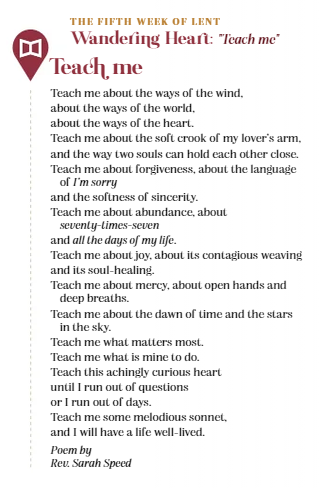
When was the last time we were open enough to say those words? In saying “teach me” we admit that we don’t know it all. In saying “teach me” we express a level of humility.
Perhaps the prayer of our hearts this day could be- Lord, teach me to forgive.
Even when it is hard.
Even when it is incomplete.
God’s grace will help us.
God’s grace is abundant.
Thanks be to God. Amen
Questions for Discussion
Do you think forgiveness is a process?
How open are you to being taught? Is being open to learning an act of humility?
What part of Peter's story inspires you?